

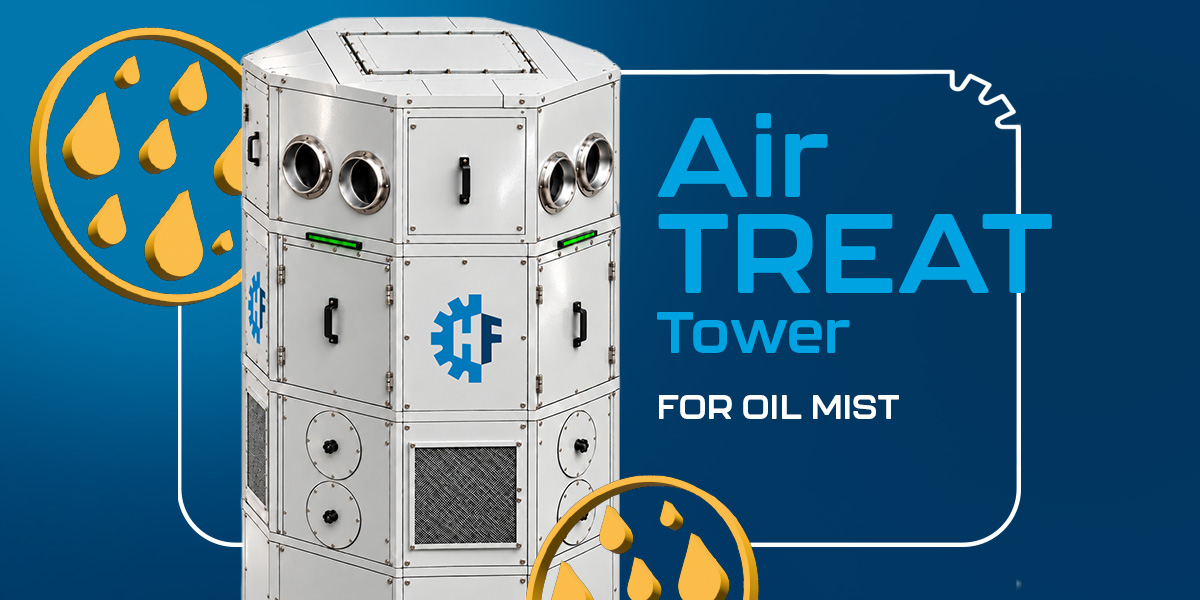
A new HF solution for diffuse oil aerosols in large production areas, with multilayer glass-fibre filtration, HEPA H13 included as standard and automatic modulating airflow.
In machining processes, air quality management often starts with the individual machine tool. But what happens when oil mist spreads beyond the machining area and affects the rest of the workshop?
HF Group expands its range with AirTREAT Tower for Oil Mist, designed to treat large volumes of air directly within the production area. The solution acts on suspended oil aerosols, helping to reduce their concentration and limit deposits on machinery, surfaces and components.
Oil mist in machining workshops: why consider the air throughout the production area?
Turning, milling, grinding and other machining processes can generate mist associated with the use of neat oils and metalworking emulsions. These are liquid particles dispersed in the air, whose formation varies depending on the process and operating conditions.
When aerosols spread beyond the machine tool, the assessment cannot stop at the individual emission point. The surrounding areas and the presence of multiple processes within the same environment must also be considered.
Three questions can help guide the assessment:
- Which fluids are used? Neat oil, emulsions or both.
- Where does the mist spread? Around the machines or across larger areas of the production environment.
- Which systems are already installed? Machine-mounted extraction systems, centralised systems or other control measures.
Managing oil mist therefore requires attention both to the emissions themselves and to the effectiveness of the containment and extraction systems already in place.
A tower for the production area, supporting existing extraction systems
AirTREAT Tower Oil Mist can complement extraction systems installed on individual machine tools, treating oil aerosols that spread throughout the production environment.
The two solutions address different needs: machine-mounted systems operate close to the source, while AirTREAT Tower treats large volumes of air within the production area.
The most suitable configuration should therefore be assessed by considering the process, the way aerosols spread and the extraction systems already in place.
Multilayer fiberglass and HEPA H13: dedicated filtration
Oil mist treatment requires a specific configuration for liquid aerosols.
AirTREAT Tower Oil Mist uses a multilayer glass-fibre primary filtration stage, designed for mist generated by processes using neat oil and emulsions. The separated contaminant is collected in a dedicated container located at the bottom of the system.
Filtration is completed by a final HEPA H13 absolute filtration stage, included as standard. Combined with the primary filtration stage, the system can achieve an overall efficiency of up to 99.99%.
This dedicated filtration configuration distinguishes the oil mist version from AirTREAT Tower Dust & Dry Fumes: the correct configuration depends on the nature of the contaminant to be treated.
Large volumes of air without a dedicated ductwork network
The tower integrates capture, filtration, ventilation and air diffusion into a single autonomous unit. It draws air from the production area, treats it and returns it through the upper diffusion system, without requiring dedicated ductwork.
The range includes models with airflow rates of up to 12,000 and 24,000 m³/h, designed for different treatment requirements. Installation can be fixed or the unit can be relocated according to the production layout.
The choice of model should always be linked to the specific application conditions. The number and arrangement of machines, the characteristics of the emissions and the treatment objectives should all be considered before selecting the most suitable configuration.
Automatic airflow management and operational efficiency
AirTREAT Tower does not require continuous manual airflow adjustments.
The system automatically adapts the airflow to the conditions detected within the production area, with the aim of limiting operation at maximum power to the periods when it is actually required and optimising energy consumption.
Filtered air is also reintroduced from the top of the unit, promoting controlled recirculation. As an additional benefit, the resulting airflow can contribute to more uniform air conditions at different heights within the industrial hall, without making destratification the primary purpose of the system.
From machining processes to application assessment
Machining centres, turning, milling, drilling, boring and grinding are some of the applications to consider. However, the main criterion remains the presence of diffuse oil mist and oily aerosols, rather than the name of the specific process alone.
For this reason, HF Group combines its technology offering with an assessment of the operating conditions. The aim is to determine how air treatment can be integrated into the production area while taking into account existing systems and operational and maintenance requirements.
Does your production area have dust and dry fumes?
If the issue involves dust, dry fumes or airborne particulate matter, AirTREAT Tower Dust & Dry Fumes is also available, with filter media selected according to the contaminant and production process.
Does oil mist spread throughout your production area? Explore the features, configurations and applications of AirTREAT Tower Oil Mist and speak with the HF team to assess the most suitable solution for your facility.
