

Dust and fumes can spread well beyond the point where they are generated, gradually affecting the entire production environment.
In large industrial halls, distributed sources, mobile workstations, large workpieces and complex layouts can make it difficult to manage all emission points exclusively through local extraction systems.
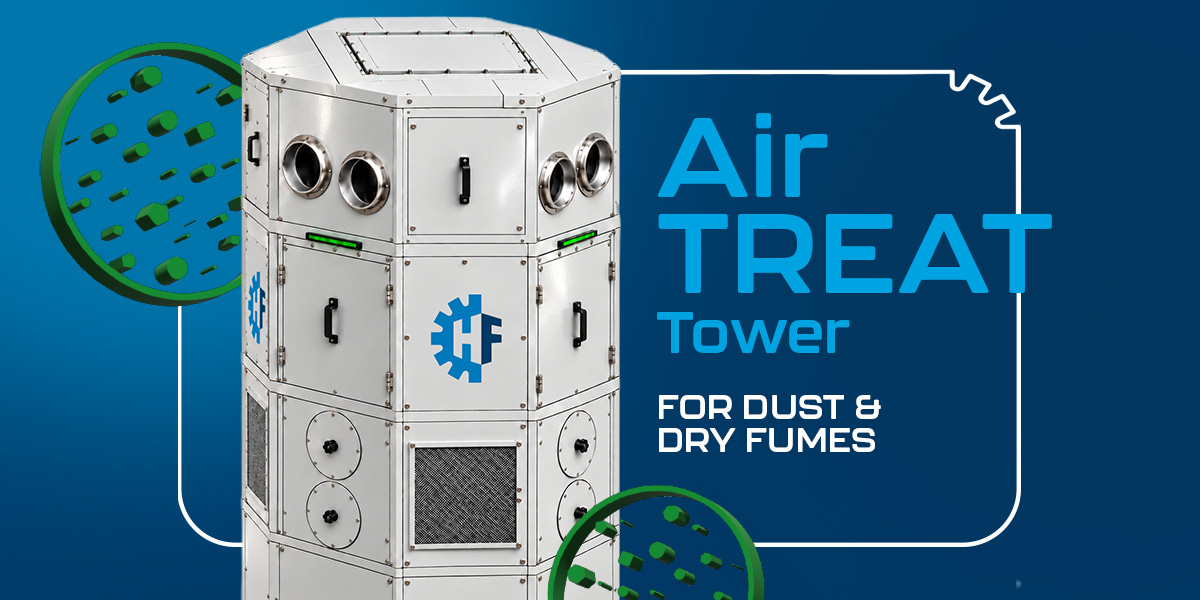
This is where AirTREAT Tower for Dust & Dry Fumes comes in: the new HF solution designed to treat large volumes of air directly within the production area and help reduce the presence of dust, dry fumes and airborne particulate matter.
When should a filtration tower be considered for diffuse dust and fumes?
AirTREAT Tower is particularly suitable when contaminants do not remain confined close to the source, but tend to spread throughout the production environment.
It can therefore represent a suitable solution in large production areas characterised by diffuse sources, distributed processes, mobile workstations or production layouts where installing a dedicated ductwork network would be complex or impractical.
The tower treats the air throughout the entire production environment through a stand-alone system integrating capture, filtration, ventilation and air diffusion.
How does the AirTREAT Tower work without ductwork?
AirTREAT Tower integrates capture, filtration, ventilation and air diffusion into a single autonomous vertical unit.
Air containing dust and fumes enters through the capture points integrated into the tower and reaches the filtration section. The integrated fan unit moves the airflow and, once treated, the filtered air is reintroduced into the production area through the upper diffusion system. The separated dust is collected in a dedicated container at the bottom of the unit.
The absence of a dedicated ductwork network allows the tower to be installed independently of connections to individual emission sources. The unit can also be relocated according to changes in the production layout. The benefit is therefore not limited to filtration performance alone, but also lies in the way the solution can be integrated into the organisation of the production environment.
Configurable filtration for Dust and Dry Fumes
Not all emissions require the same filter element. For this reason, the primary filtration stage of AirTREAT Tower is selected according to the contaminant and the process.
Available options include polyester, antistatic polyester for specific dust applications, and a polyester-cellulose blend, for example for welding fume applications. For dust applications, the system can be configured with self-cleaning cartridges.
The treatment is completed by a final HEPA H13 absolute filtration stage included as standard. The combination of the two filtration stages enables the system to achieve an overall efficiency of up to 99.99%. This value refers to the filtration system as a whole, not to the final filter alone.
Modulating airflow: treating the air according to production needs
Airflow management is one of the key features of AirTREAT Tower.
The system automatically adjusts the airflow according to the conditions detected within the production environment: when the contaminant load increases, the airflow rises; when it decreases, the airflow is reduced.
The aim is to contain energy consumption compared with constant operation at maximum airflow, while also avoiding continuous manual adjustments by operators. The tower therefore adapts its operation to the actual requirements of the production area instead of operating continuously at maximum power.
Filtered air is also reintroduced from the top of the unit, promoting controlled recirculation throughout the industrial hall. The resulting airflow can help create more uniform air conditions at different heights within the production environment.
Air destratification can therefore represent an additional benefit of the recirculation generated by AirTREAT Tower.
Which configuration should you choose for your facility?
The range includes AirTREAT Tower 12, with airflow rates of up to 12,000 m³/h, and AirTREAT Tower 24, with airflow rates of up to 24,000 m³/h.
However, the choice should not be based solely on the number of cubic metres of air that can be treated. The contaminant, operating conditions, arrangement of emission sources and existing extraction systems should also be considered.
For production, maintenance and environmental managers, this means assessing the solution within the actual production process rather than as an isolated piece of equipment. This is the approach HF Group uses to analyse plant requirements and identify the technologies and configurations best suited to each application.
Does your production area have diffuse oil mist?
If your processes use neat oil or emulsions, AirTREAT Tower for oil mist is also available, configured with multilayer glass-fibre filter elements specifically designed for the treatment of oil aerosols.
Would you like to learn more about our HF tower for dust and dry fumes? Explore its features, configurations and applications, and speak with our team to assess how it can be integrated into your production environment.
