

In the debate on environmental sustainability, industrial companies are often identified as one of the main sources of emissions and environmental impact.
And that is true: production activities significantly contribute to atmospheric emissions.
But it is equally true that companies can be an active part of the solution.
In recent years, more and more companies are investing in concrete technologies, processes and projects to reduce their environmental impact and contribute to the local area in a positive way.
Projects like Human&Friendly are born from this very awareness.
Human&Friendly: a project created to improve air quality.
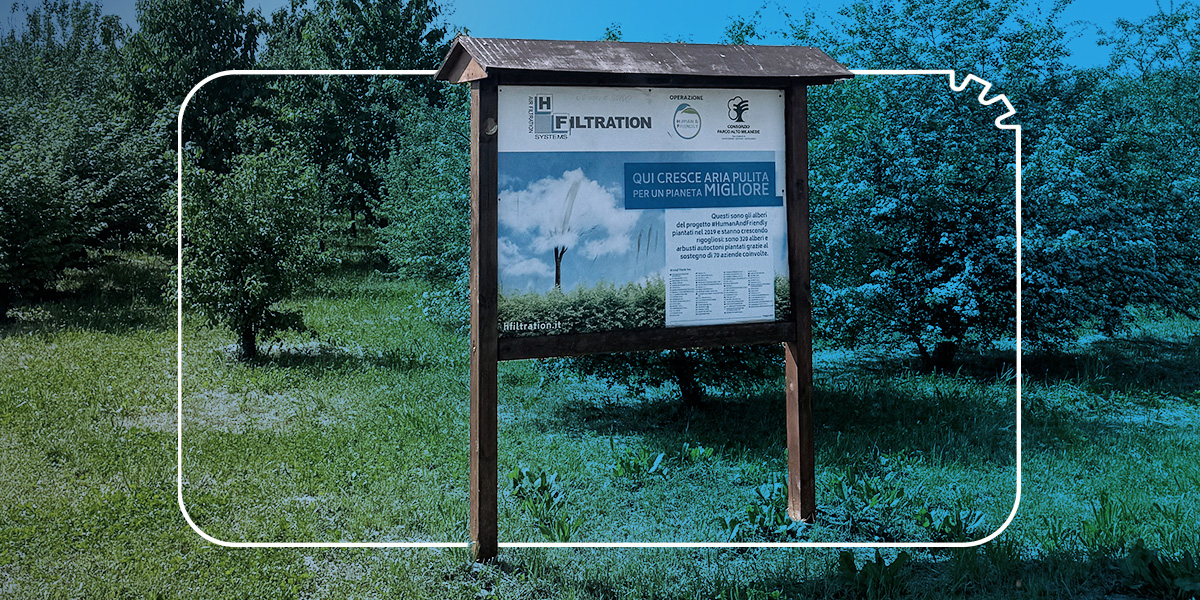
In 2019, HF Group launched the Human&Friendly project with a clear goal: to make a concrete contribution to improving air quality.
The motto that guided the initiative is simple but meaningful: "Clean air for a better planet."
From this vision came a tangible commitment offered to customers: for every €5,000 in orders received, HF Group pledged to plant a tree in a dedicated green area.
A simple gesture, but one with a real and measurable impact. Over the years, the project has led to concrete results:
- 320 shrubs planted
- repopulation of local vegetation
- return of wildlife to the area
- official support from the Consorzio Parco Alto Milanese
Today, 7 years later, that area has become a growing forest, capable of generating tangible environmental benefits.
According to estimates, within about ten years of its creation, this green area will be able to absorb about 100 kg of CO₂ per day.
A figure that clearly shows how even local actions can contribute meaningfully to emission reduction.
Companies: from the problem to part of the solution
Today, industrial companies play an increasingly central role in the transition to more sustainable production models.
This means acting on multiple levels:
- reducing atmospheric emissions
- improving plant efficiency
- adopting filtration and abatement technologies
- developing concrete environmental projects
Human&Friendly represents exactly this: an example of how a company can combine technological innovation with a real commitment to the local area.
It is not just about offsetting impact, but about actively contributing to environmental improvement.
A commitment that continues to grow
Seven years on, Human&Friendly is not just a tree-planting initiative, but a symbol of a broader approach to sustainability.
An approach that combines:
- technology
- environmental responsibility
- concrete actions
Today the project has reached an important milestone: the planted area has evolved into a real forest, capable of developing naturally and independently.
For this reason, this will be the last year in which the area will be under the direct management of HF Group. A natural transition that reflects the maturity of the ecosystem and its ability to sustain itself over time.
However, this does not mean stepping away from the project. HF Group will continue to monitor the area and intervene when necessary to ensure its health and future development.
For HF Group, improving air quality does not only mean developing industrial filtration solutions, but also contributing to projects that are designed to last over time.
Because today more than ever, companies are not just part of the problem. They can, and must, be part of the solution.
Do you want to find out how HFiltration solutions help reduce emissions and improve air quality in industrial processes?
