

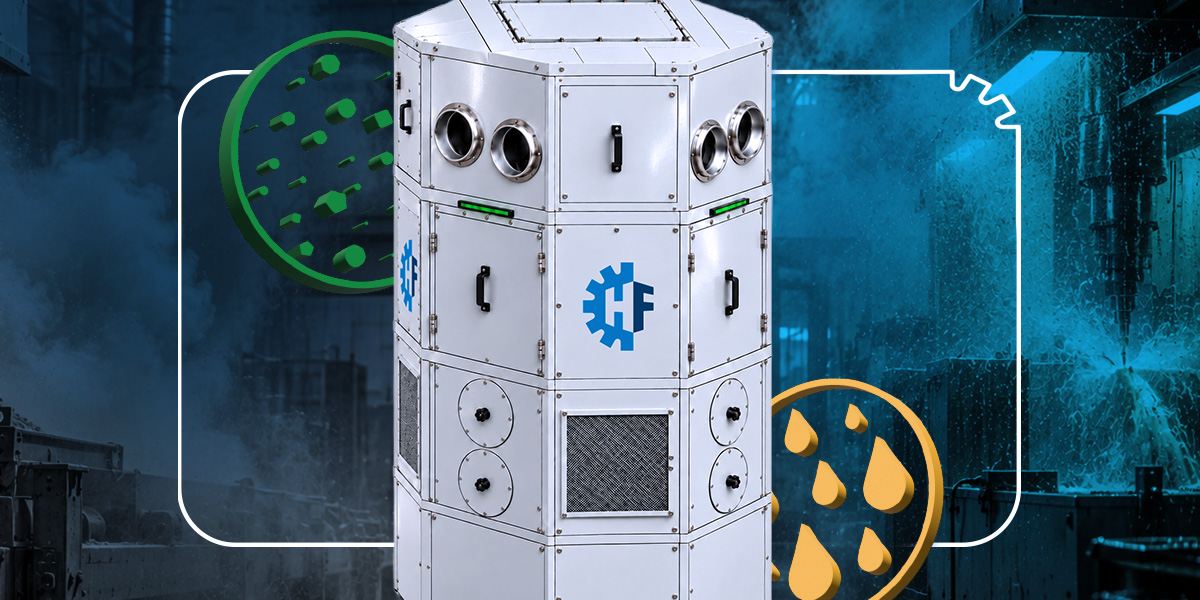
Dust, dry fumes and oil mist can spread throughout production environments, but they have different characteristics and require specific filtration technologies.
This is the principle behind AirTREAT Tower, HFiltration's new solution for treating large volumes of air in industrial production areas.
The range includes two versions:
Both versions share the same tower concept, but their filtration configurations differ depending on the type of contaminant to be treated.
Why is the AirTREAT Tower available in two versions?
When choosing an industrial filtration system, one of the first factors to consider is the nature of the contaminant.
Dust and dry fumes consist of airborne solid particulates. Oil mists, on the other hand, are liquid aerosols that can be generated, for example, during machining processes using pure oil or emulsions.
Two different contaminants therefore require different filtration systems.
For this reason, the AirTREAT Tower does not use a universal configuration but has been developed in two specific versions, both designed to treat the air directly within the production environment.
AirTREAT Tower for Dust and Dry Fumes
AirTREAT Tower for Dry Dust and Fumes is designed to treat dust, dry fumes, and airborne particulate matter.
In this configuration, the first filtration stage is selected according to the characteristics of the contaminant and the production process.
Available filter media include polyester, antistatic polyester for specific types of dust, and a polyester-cellulose blend, which can be used, for example, in applications involving dry welding fumes.
For dust applications, the system can also be equipped with self-cleaning filter cartridges. The separated dust is collected in a dedicated container located at the bottom of the tower.
The filtration process is completed by a standard HEPA H13 final filtration stage. The combination of different filtration stages enables the system to achieve an overall filtration efficiency of up to 99.99%, depending on the configuration.
This version is particularly suitable for consideration in production areas with multiple dispersed emission sources, mobile workstations, large workpieces or layouts where installing ductwork for every individual emission point would be complex.
AirTREAT Tower for Oil Mists
The AirTREAT Tower for Oil Mists, on the other hand, is designed to treat oil mists and aerosols that can spread throughout the environment beyond a single machine tool.
In this version, the first filtration stage uses multilayer fiberglass filter elements, specifically designed to capture liquid aerosols.
The configuration is suitable for machining operations using both neat oils and emulsions.
The separated contaminant is collected at the bottom of the system. As with the Dust and Dry Fumes version, the final filtration stage consists of a standard HEPA H13 high-efficiency filter.
Combined with primary filtration, the system can achieve an overall filtration efficiency of up to 99.99%.
AirTREAT Tower for Oil Mist is therefore designed for machine shops and production areas where oily aerosols tend to spread beyond the point where they are generated.
What are the main differences?
The fundamental difference between the two AirTREAT Tower versions lies in the type of contaminant and the filtration technology used to treat it.
AirTREAT Tower for Dust and Dry Fumes
- Treats solid particulate matter, dust and dry fumes.
- Uses filter media that can be configured according to the application.
- Can be equipped with self-cleaning cartridges for dust applications.
- Includes a HEPA H13 final filtration stage.
AirTREAT Tower for Oil Mist
- Treats oil mist and liquid aerosols.
- Uses multilayer fiberglass filter elements.
- Is suitable for machining operations using neat oils and emulsions.
- Includes a HEPA H13 final filtration stage.
Although they employ different filtration systems, both configurations share the operating principle of the AirTREAT Tower series.
Both integrate air intake, filtration, ventilation, and distribution of treated air into a single stand-alone unit, without requiring a complex dedicated ductwork system.
The availability of two versions allows for maintaining the same concept of ambient air treatment while adapting the filtration technology to the actual characteristics of the contaminant. This is the principle behind the AirTREAT Tower: not a universal configuration, but two solutions tailored to different contaminants, developed to integrate into various production environments and applications.
Are dust, dry fumes, or oil mists present in your facility?
Discover the two versions of the AirTREAT Tower or contact the HFiltration team to identify the solution best suited to your application.

