

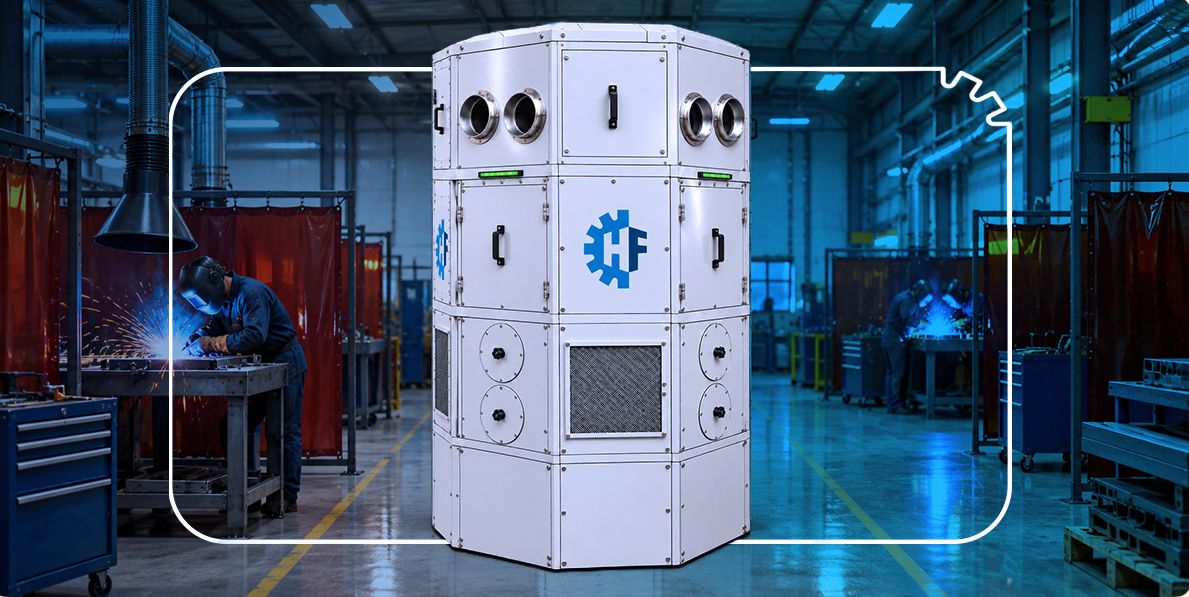
A large manufacturing facility can be equipped with efficient extraction systems and still have dust, fumes or aerosols suspended in the air.
The reason is simple: not all contaminants generated by industrial processes are necessarily captured at the source. Some may escape extraction, spread between workstations and remain in the production environment.
In industrial facilities, where numerous machines, different processes and large volumes of air coexist, controlling airborne contamination can be particularly challenging.
So how can companies improve air quality throughout the entire production area, including contaminants that are not fully captured by local extraction systems?
Why does the air remain contaminated in large industrial spaces?The presence of airborne contaminants depends on the processes carried out and the conditions within the production environment.
Operations such as welding, cutting, grinding and machining can generate dust, dry fumes and oil mist which, if not completely captured, can spread into the surrounding air.
This issue is particularly common in facilities with:
- Workstations that frequently change position
- Machinery distributed across large production areas
- Multiple sources of contamination
- Large components and workpieces
- Layouts that make effective local extraction difficult
Air movements caused by ventilation, open doors and production activities can also influence how contaminants spread throughout the facility.
The consequences go beyond the quality of the air operators breathe. Airborne particles can also settle on machinery, surfaces, electrical cabinets and production equipment, increasing cleaning and maintenance requirements.
Source extraction and ambient air filtration: two complementary strategies
Source extraction remains the first measure to consider when controlling industrial airborne contaminants.
Capturing dust, fumes and aerosols where they are generated helps prevent them from spreading throughout the production environment. However, in certain situations, local extraction alone may not be sufficient.
Consider, for example, a welding department where workstations frequently change position, or a machine shop where residual oil mist can spread beyond individual machine tools.
In these situations, ambient air filtration can complement existing extraction systems by treating contaminants that have already dispersed throughout the production area.
The goal is not to replace source extraction, but to support it with a solution capable of treating the air circulating throughout the entire production environment.
How can airborne contaminants be reduced in manufacturing facilities?
Improving air quality in an industrial facility is not simply a matter of increasing ventilation.
To identify an effective solution, several factors must be considered:
- Size and volume of the production area
- Location of contamination sources
- Type and concentration of contaminants
- Airflow patterns
- Existing extraction systems
- Workstation layout and configuration
An ambient air filtration system must be able to capture contaminated air, treat it through suitable filtration stages and redistribute the filtered air according to the characteristics of the production area.
Selecting the appropriate filtration technology is equally important.
For example, dust and fumes generated by welding operations require a different treatment approach from oil mist produced by machine tools using neat oils or emulsions.
This is why choosing an industrial air filtration system should always begin with an assessment of actual operating conditions and the contaminants present.
AirTREAT Tower: a solution for air treatment in large industrial environments
To meet the air treatment needs of manufacturing facilities, HFiltration has developed the AirTREAT Tower, a stand-alone filtration tower designed to treat large volumes of air directly on the shop floor, without requiring a dedicated ductwork system.
The system integrates air intake, filtration, ventilation, and distribution of treated air, with automatic flow rate control.
AirTREAT Tower is available in two configurations designed for different contaminants:
Improving air quality means looking beyond individual sources and considering the entire production environment. When a portion of dust, fumes, or aerosols escapes localized capture, ambient air treatment can complement existing systems and help maintain cleaner, more controlled working conditions.
Do pollutants in your facility spread beyond workstations?
Discover the AirTREAT Tower or contact our team to evaluate the solution best suited to your production environment!

